LIFE WITH A TWIST: DISCOVERING THE PURPOSES OF THAT STRANGE BILL
This article looks at the structure of that peculiar bill, and charts how early naturalists and researchers unravelled its function and possible evolution. It is adapted from Shorebirds of New Zealand: sharing the margins (2012) by Keith Woodley.
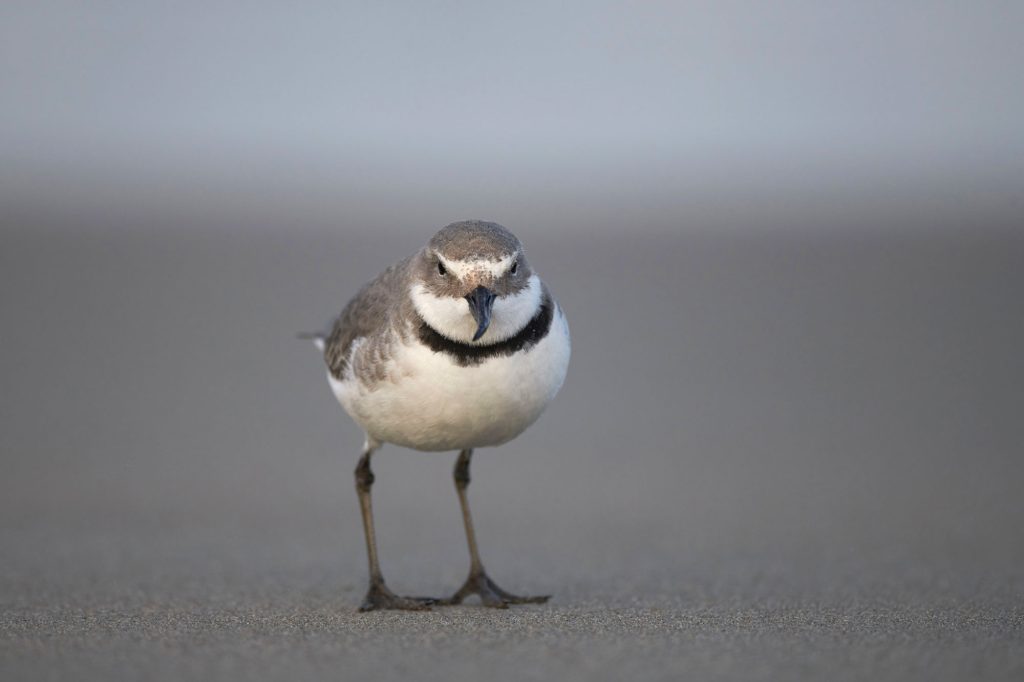
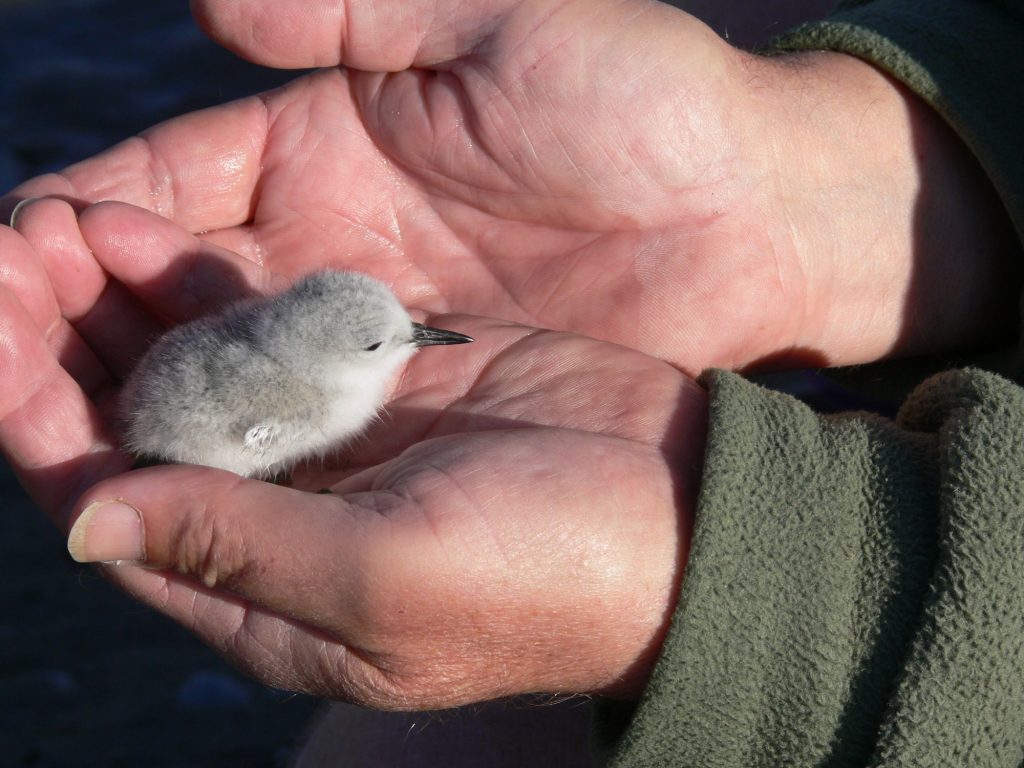
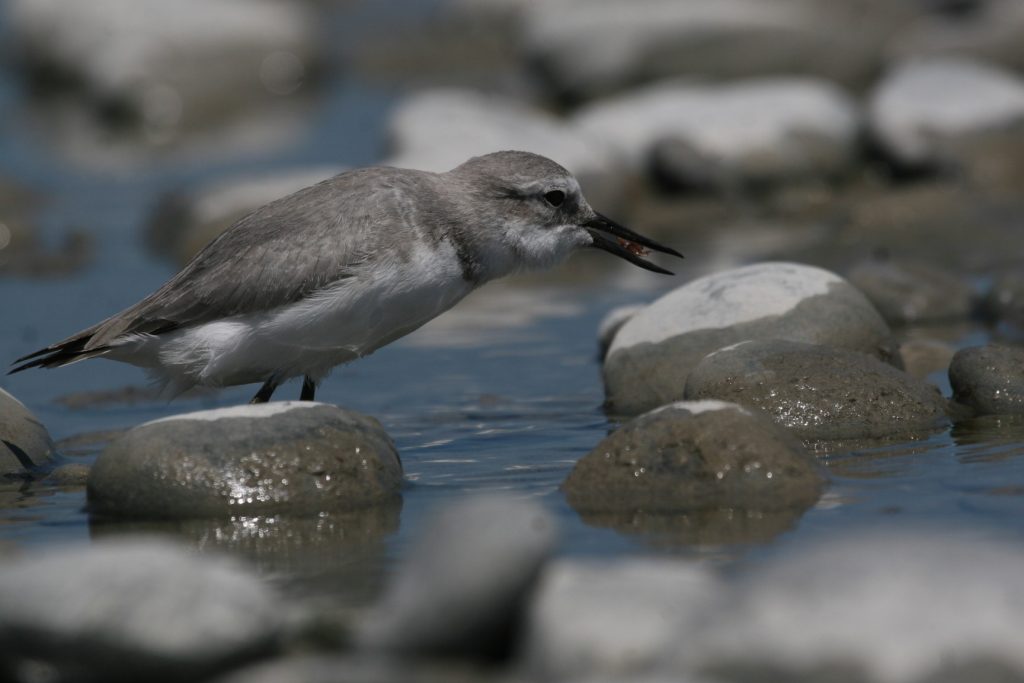
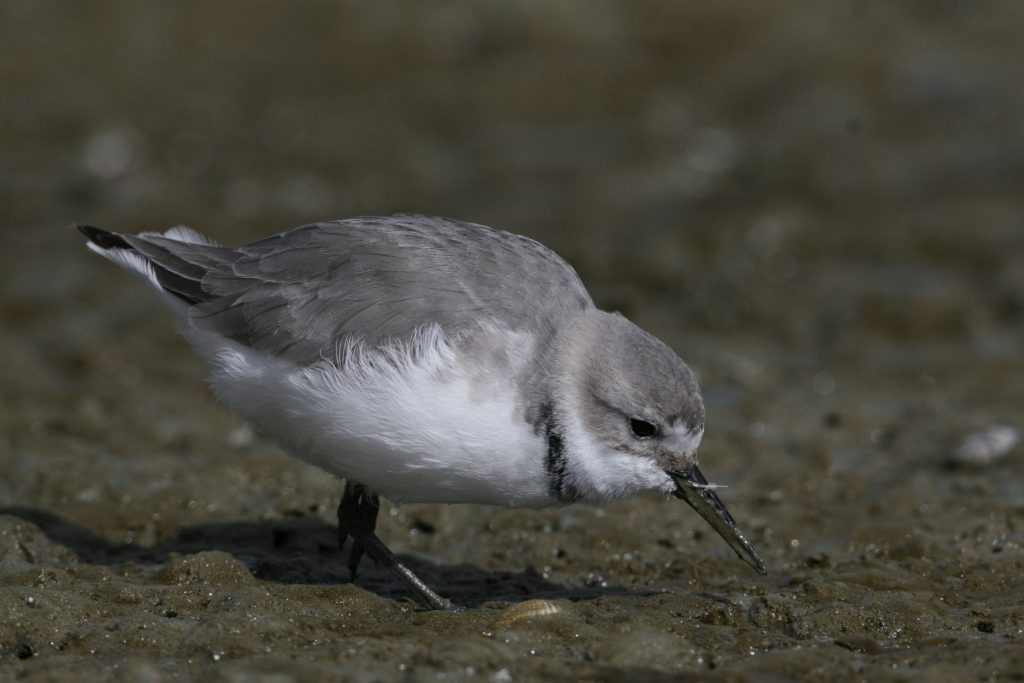
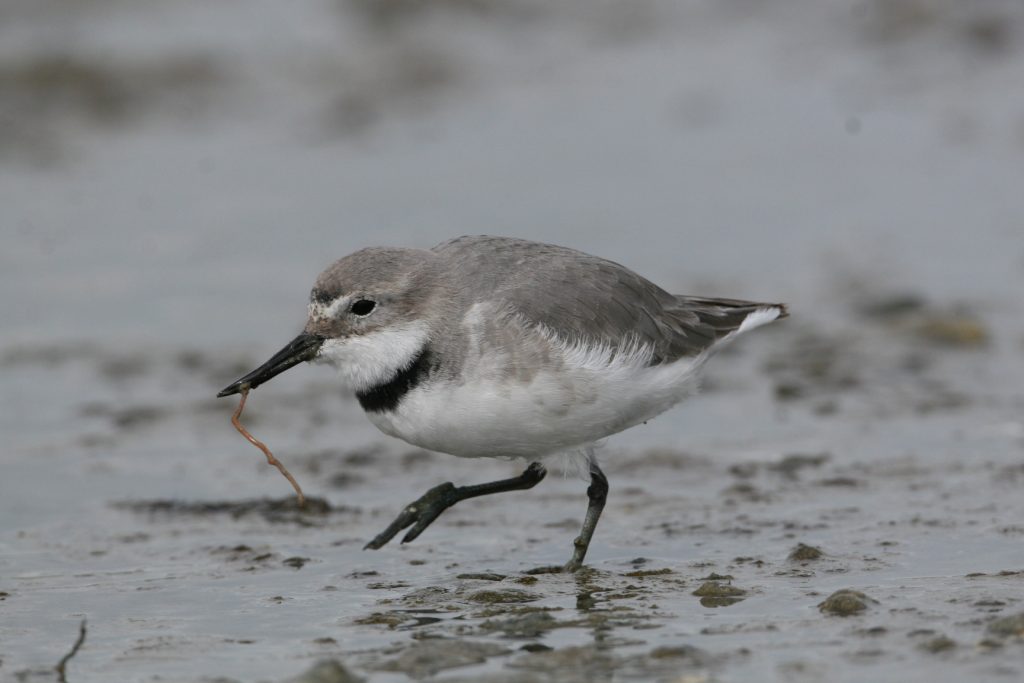
In 1879 early Canterbury naturalist Thomas Potts presented this description to the New Zealand Institute. ‘Longer than the bird’s head, the black bill is pointed, curved to the right and curled slightly in itself in a leaf-like manner. From the base of the bill the upper mandible is flattened on the top for a distance, then becomes raised and slightly rounded, till it gradually sweeps down into the point. But it is not just curved to the side. At the base, the bill is symmetrical in section, with the mandibles being of similar width. In the region of the curve, however, the concave edge of each half of the bill curls inward while, on the convex side, the upper mandible closes over and overlaps the lower. This asymmetry becomes less pronounced towards the tip of the bill where the edges of the mandibles meet normally and the section is once more symmetrical. The result is a structure which, when closed, leaves an opening on the concave side in the region of the curve.’ Potts went on to say the bill resembled ‘a curved pipe, with a very slight twist.’ The effect is that ‘with the left side laid lowermost, it has the potential to be used like a spoon.’ Even within the bird kingdom, with its diversity of bill shapes and sizes, this is an odd instrument. What is its purpose?
Observing the birds on their riverbed breeding grounds, Potts concluded the bill was specifically adapted for that stony environment. ‘The horny point of the bill…is sufficiently strong to be used for thrusting between and under stones and pebbles.’ The very structure of the bill – the long grooves and flattened form of the upper mandible – ‘tends materially to assist the bird in fitting its curved bill close to a stone, and thus aids it in searching… beneath the shingle for its food, while at the same time the closed mandibles would form a tube through which water and insects could be drawn up, as water is sucked up by a syringe.’ This enabled the bird to follow its prey ‘by making the circuit of a water worn stone with far greater ease than if it had been furnished with the straight beak of the plover, or the long flexible scoop of the avocet.’ For Potts this was conclusive: ‘It must clear away any little cloud of doubt…that this singular form of bill, so far from being an accidental deformity, is a beautiful provision of Nature, which confers on a plover-like bird the advantage of being able to secure a share of its food from sources whence it would be otherwise unattainable.’
Walter Buller certainly supported this interpretation, but others, including one of his regular sparring partners, were not so sure. Frederick Hutton, then assistant geologist to the Geological Survey Department, questioned whether; in making the circuit of the stone in pursuit of prey, the Wrybill would need to see around a corner.
Which raises an interesting point: if the bill is designed for the stony riverbeds where Wrybill breed, what about where they spend most of the year – those soft tidal flats of places like Manukau Harbour and Firth of Thames where there are no stones? Hutton correctly pointed out, ‘the bird is just as common…on the mud-flats of the Manukau Harbour, where there are no stones, as it is in the shingle-beds of the rivers of the South Island; and…I have often watched the bird feeding and never yet saw it run round a stone more than any other bird might do.’
Observers there noticed the favourite food of Wrybill were minute but numerous organisms hidden among fine algae. Hutton: ‘By slightly inclining its head it could lay a considerable part of its bill flat on the ground, and thus, in the first case, take up a much larger quantity of those minute organisms at a time, or, in the latter, could search over a greater extent of Algae for creatures that it could not see, than if it used only the point of the bill. The broad bill of the duck performs the same office in a different manner.’ However, he was also careful to point out he had not directly observed this for himself. ‘I by no means assert…that this is the use of the peculiar shape of the bill; for I have had no opportunity of observing one through a telescope when feeding, neither have I examined the contents of the stomach to ascertain on what they feed; but it must be remembered that the curve in the bill would not prevent the bird from eating insects and other animals also.’
Canterbury ornithologist, hunter and collector Edgar Stead was also sceptical. He thought there ‘can be very few occasions when the peculiarity is of any decided benefit to its possessor, for over nearly all the riverbeds on which the bird feeds, the stones are so much buried in sand as to make the bent bill quite unnecessary.’ Stead joined Hutton in pointing out that Wrybill spend only a few months on the riverbeds, and the rest of the year living ‘on mudflats, and sea beaches, where its abnormality can be of no benefit.’ Hutton’s point was well made: if a bird spends more of its year on soft mudflats than among river gravel should it not be adapted more for that habitat? In one of his classic works on New Zealand fauna, Birdlife of Island and Shore, Herbert Guthrie-Smith pondered the same question. Watching Wrybill foraging over sand flats on a receding tide he speculated ‘whether the sweeping scythe-like action in feeding, a skimming of the surface of the wet sand, had helped to modify the remarkable crooked bill of the species, or had been adopted in consequence of it.’
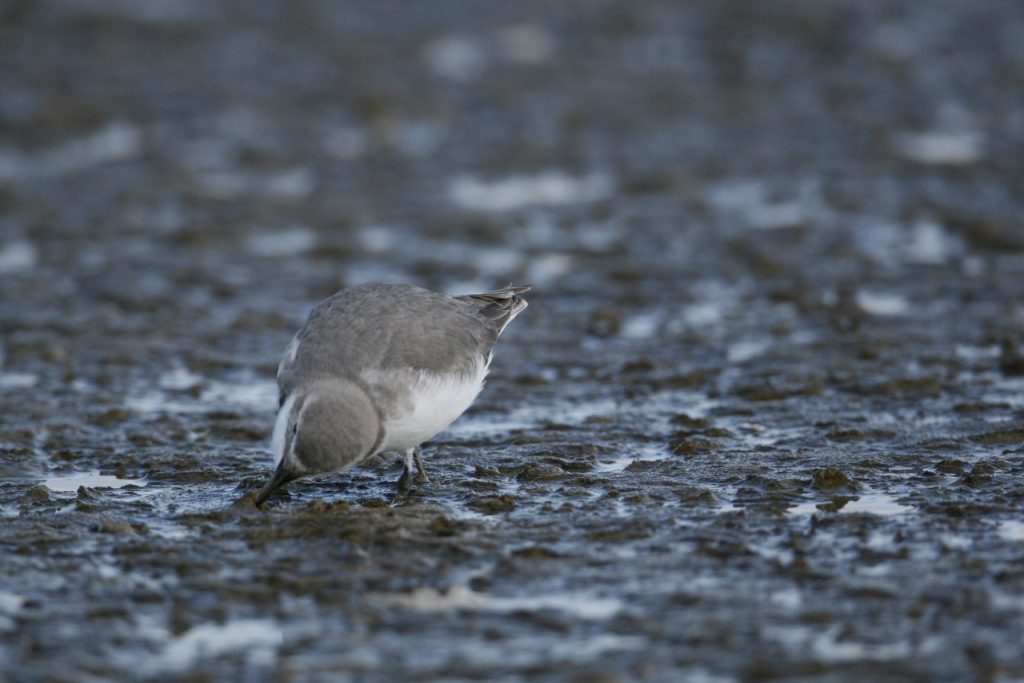
The debate continued into the 1970s. Graham Turbott, then Director of Auckland Museum, and familiar with Wrybill from the harbours around Auckland, was intrigued not only by the bill shape, but also by the feeding actions employed. ‘The birds as they feed over the soft mud predominantly sweep the head sideways, the action being from right to left, that is, against the ‘right handed’ curve of the bill; such an action means the whole side of the front…portion of the bill from angle to tip becomes functional as a grasping and gathering mechanism, and it seems justifiable to suppose that the bill possesses a relatively high efficiency for mudflat feeding when used this way.’
He observed the bill-tip was also used in more conventional fashion to merely pick up an item, but when doing so ‘the stroke is also down and to the left.’ For him there ‘can be no doubt concerning the adaptive significance of the shape of the bill.’ Other waders such as pied stilt on mud will turn the bill ‘along the flat’ to pick up food items – but with a straight bill this is done with some effort and ‘the bird’s face may in extreme cases go down until almost touching the mud; In comparison the Wrybill’s action against the side of the bill is both deft and effective.’ Turbott was also of the view that food taken on shingle beds during the breeding season is derived mainly from ‘soft, muddy drifts in the riverbeds and softer interstices between the shingle’ and is comparatively rarely sought under the stones themselves.
In 1979 ecologist Ray Pierce published a seminal paper addressing the Wrybill debate. He considered the ‘gaps and contradictions in the knowledge of Wrybill feeding on riverbeds, [were] largely because authors have formed impressions rather than made quantitative measurements.’ Pierce grew up in South Canterbury and through family camping and fishing trips, came to know the lakes and riverbeds of the central South Island very well. ‘I would get on the end of a fishing line and would not do very well food wise but would see a lot of things passing by –terns, grebes, coots and…I saw my first Wrybill on a fishing trip on the Rakitata, and black stilts at the mouth of the Cass.’ In considering a subject for his Post-graduate Diploma he found in Wrybill a prime candidate. Surprisingly, apart from some Wildlife Service riverbed counts in the 1960s, no one had focused on them. His paper reported findings from an extensive study of birds on the Rakaia, and the Cass River, which flows into Lake Tekapo.
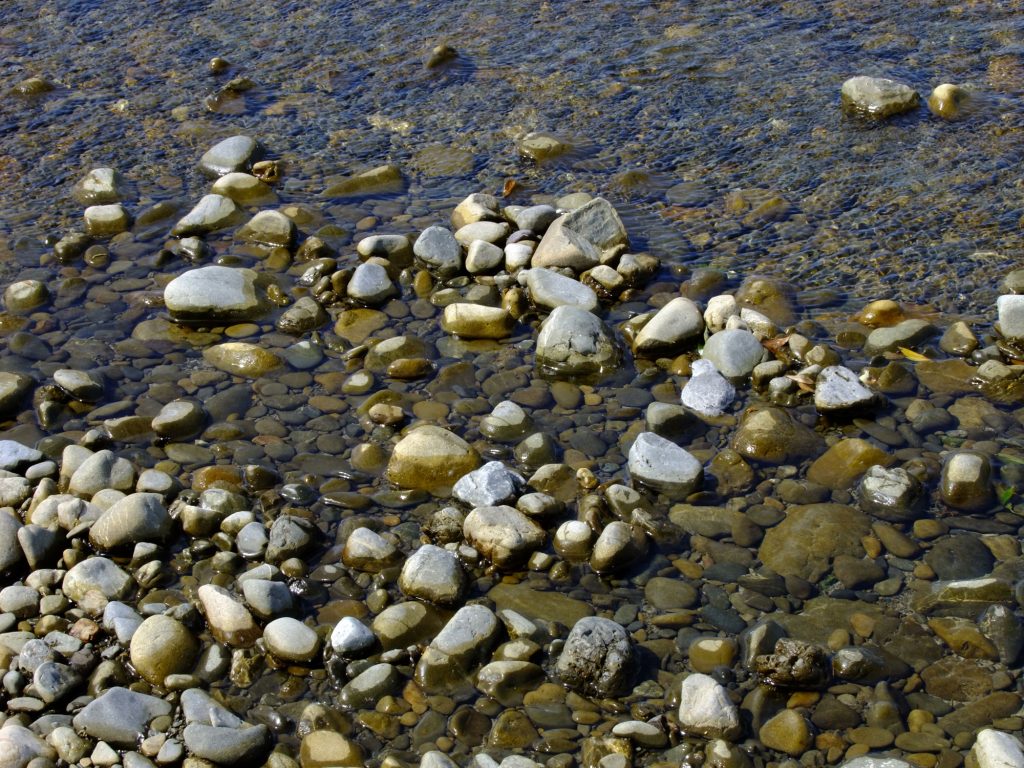
In the study area on the Rakaia – patches of sand were sometimes extensive at the edge of streams, and silt commonly settled on streambeds in areas of quieter water but was generally absent from riffles or rapids. Stones were typically smoothly rounded. Main food items for Wrybill were caddisfly and mayfly larvae, and their location was quite significant. ‘In both study areas may fly larvae were found to be negatively phototactic, clinging to the under surface of stones during the day. Stones that were free of silt and partly covered in algae normally supported mayflies. These conditions were characteristic of the riffles, and it was here that mayflies were most abundant and Wrybills most frequent.’ The highest mayfly densities on both rivers were found in riffles and not in the ‘soft, muddy drifts on the riverbeds and softer interstices between shingle’ mentioned by Turbott and others. Pierce found such areas, as well as backwashes and transitional areas, had low mayfly densities and were not favoured by Wrybills.
He noted three feeding actions: a direct peck consisting of a rapid movement after which the bill is quickly withdrawn; a clockwise movement where the head is tilted to the left followed by a left to right bill movement; and probing where the bill is pushed at a steep angle into the streambed. Nearly 60 percent of bill movements in both study areas were direct pecks, most of them ‘in-water’ and ‘probably directed mainly at benthic prey, because bottom-dwelling mayfly and caddisfly larvae were frequently seen captured.’ Moving targets were often suggested. ‘It is likely direct pecks to the base of a stone may have been directed at mayfly larvae which, having detected the approaching bird, were seeking shelter of stones.’ About 25 percent of bill movements were clockwise movements, where in most cases the bill was pushed under a stone where prey seemed felt for rather than seen. In some cases, clockwise movements were used exclusively throughout the period of observation, though usually this method was interchanged with direct pecks. Pierce found probing was used less often than other feeding techniques, usually occurring only in areas of small stones.
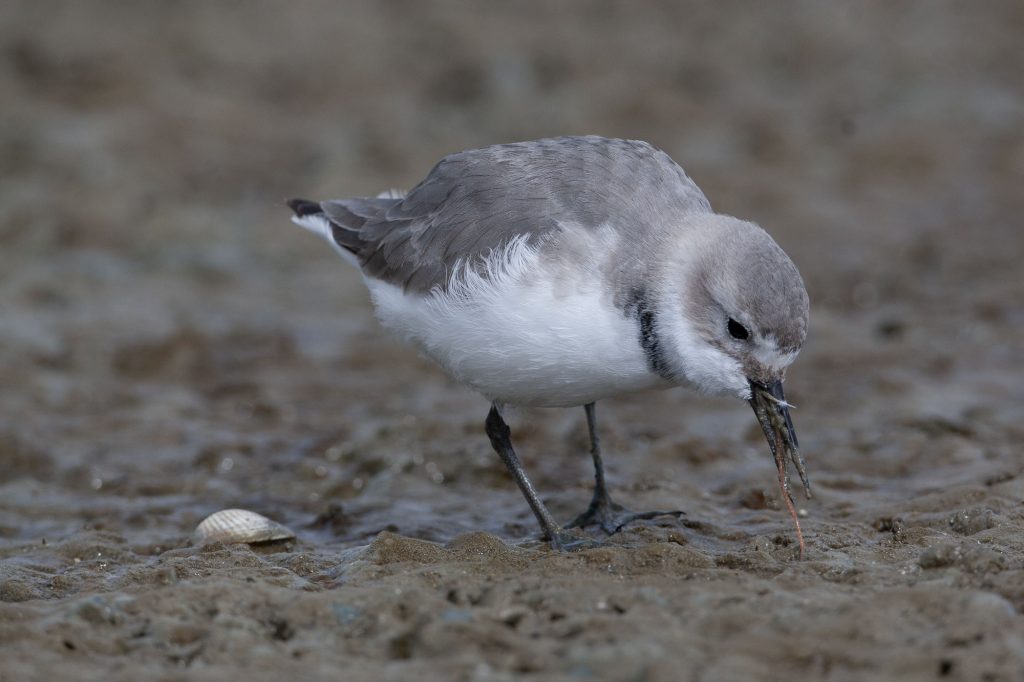
But what about when Wrybills are on the northern harbours and estuaries? On the Firth of Thames, they are seen feeding on worms such as Nicon and Orbinia commonly found in the upper stratum of the mudflats. But much of their foraging is closely associated with wet sediment, where they appear to be feeding on biofilm. In Auckland, they sometimes shift from the Manukau Harbour to the Tamaki Estuary to feed in the soft mud exposed by the outgoing tide.
Having noted the spoon-like structure formed between the upper and lower mandibles, Rod Hay, during a PhD study in the late 1970s, looked for an apparent use of it on the riverbeds, and found no indication that ‘spooning’ or ‘sweep feeding’ was common. On the northern mudflats however, it was characteristic being used 31 percent of the time. ‘In each feeding action the bill was thrust sideways, as it was being closed, to the right and into water overlaying the surface of the mud or into the mud itself. Only a step or two was taken before the next bill movement took place.’ Using a probe in the mud to simulate this action, Hay found the disturbance caused large numbers of small crustaceans resting on the mud surface to enter the water column. Once the disturbance stopped the animals took less than a second to settle, so a bird had to be quick to take advantage, explaining the high feeding rates recorded in the study.
In cooler conditions, such as early in the morning, or during late winter and early spring when water temperatures are cooler, much aquatic fauna are inactive, so Wrybill food is less available. At such time most feeding actions were tactile, particularly with clockwise movements where the ‘curvature of the bill assisted prey capture. The bill appears to be pre-adapted for obtaining mayfly and caddisfly larvae from their inactive diurnal positions on the underside of submerged stones.’ The bent bill was also useful for gleaning visible larvae from the curved surfaces of stones; it can be opened sideways to the surface of a stone giving freedom of movement for catching prey. Birds with more orthodox bills such as banded dotterels, or even the upturned bill of a terek sandpiper, lack these advantages. The latter is quite unsuitable, as the mandibles cannot be opened effectively under a stone.
During poor feeding conditions, Pierce noted other species also employed tactile methods; black stilts and pied oystercatchers were observed probing under stones, and black- billed gulls used foot-paddling to try and stir up benthic insects. But with mayfly and stonefly emergence in early afternoon, river birds are then able to forage by sight alone. It is these observations during times when food was scarcer that led Pierce to speculate on possible origins of that peculiar bill.
The lateral symmetry of a Wrybill is advantageous during difficult feeding conditions when prey is less accessible. Comparing the two stilts, he suggests Pied Stilt are at a disadvantage at such times, using a lot of energy walking around seeking prey, or moving from the channels to better feeding areas. Black Stilts are better able to cope; their larger, stronger bill, and higher insulation, mean they can get in the river and rake. Pied Stilts seem reluctant to do this, probably because their finer bill is more sensitive and prone to abrasion.
Furthermore, the Wrybill adaptation for foraging in soft sediments also applies in the Mackenzie Basin. On exposed mudflats round lake and lagoon edges when water levels drop, chironomid larvae and tubificid worms can be abundant for a time. It ‘is great tucker, especially the chironomids, and Wrybills really go berserk on them.’ During extreme floods when breeding conditions are particularly poor, birds leave the rivers as soon as they can, but ‘even in those hard times we would sometimes see them go to muddy edge lagoons.’ However, such habitats only occur in perhaps 10 percent of Wrybill-breeding range: for example, ‘the Rakaia doesn’t have many associated damp areas that they could go to.’
‘Any behavioural or morphological modifications that increases the ability of these birds to capture prey during this potentially difficult time, clearly has survival value.’ Pierce suggests such adaptations were probably more important to Wrybill than other species. Their shorter legs prevent foraging with stilts in deeper water where prey density is often high, and small birds are probably susceptible to heat loss in very cold conditions, so a combination of subzero temperatures which frequently occur in late winter and spring, and a low intake of food could be fatal. ‘One can speculate,’ wrote Pierce, ‘that a bent bill had even more survival value during the glacial epochs of the Pleistocene Period, when many New Zealand bird species probably became extinct.’
The shorebird fossil record for New Zealand is rather sparse, and there may be important absences from it. For instance, suggests Canterbury Museum vertebrate curator Paul Schofield, a species such as Wrybill may have had more than one relative or competitor at a given time all of which became extinct, it being the only one to survive because of its adaptation. ‘Because of high mortality rates, evolutionary forces are strongest during bad years, [and] in the case of Wrybill, such forces may have been particularly strong during prolonged cool periods. A scarcity of riparian insects and comparatively stable riverbeds (both results of a cold climate) coupled with heat-loss problems, would have selected for improved feeding techniques in the aquatic habitat. The bent bill may have permitted efficient food intake, allowing the species to persist through adverse climatic conditions, such as occurred during the glacial epochs.’
But if that is the case, why has such an adaptation not occurred elsewhere in the bird kingdom where, presumably, similar habitat factors occur? Hay presented three hypotheses.
- a feature could arise rapidly in a small and isolated population.
- conditions in New Zealand are unique.
- or the occurrence of mutation giving rise to the curvature is so rare it just has not occurred elsewhere.
Certainly, the braided river systems are rare globally and only one other shorebird – the Ibisbill in the Himalayas, appears restricted to such areas. Investigating this, Pierce found that while habitat conditions in the Himalayan rivers were broadly similar, the nature of Ibisbill invertebrate prey was different, because they were on the riverbeds with large prey actually sheltering under stones so they could go around or over stones and still open their beak and grasp them. They didn’t have an issue where larvae would cling to the undersurface of stones.’
Hay concluded: ‘Given the insularity of Wrybill range, its small population, and the relatively unusual nature of its braided river habitat, origin of the curvature is most likely the result of selection of natural variability in the breeding grounds. Selection then acted on this structure, probably because of competition on mudflat habitat to produce feeding behaviour and secondary asymmetry that characterize this species.’
Another question arises: is the oddly shaped bill reflected elsewhere in Wrybill anatomy? There is no significant asymmetry in skull structure, nor are there any other unusual features in the rest of the skull which is closely similar to that of most other Anarhynchus species. Interestingly some asymmetry of the skull at the base of the bill is found in oystercatchers ‘which also lay the head to the left when feeding, but in this case the bill is used to make forceful attacks on molluscs while in this position.’ In Wrybill no asymmetry is found in the jaw and tongue muscles, or in neck muscles. Typical of most shorebirds is rhyncokinesis – where the upper mandible is flexible and can bend upwards. In most plovers the bending zone starts relatively close to the skull, while in other birds such as snipe and curlews it is narrower and is situated farther forward in the bill. The Wrybill is a typical plover with a wide bending zone centred near the midpoint of its bill.
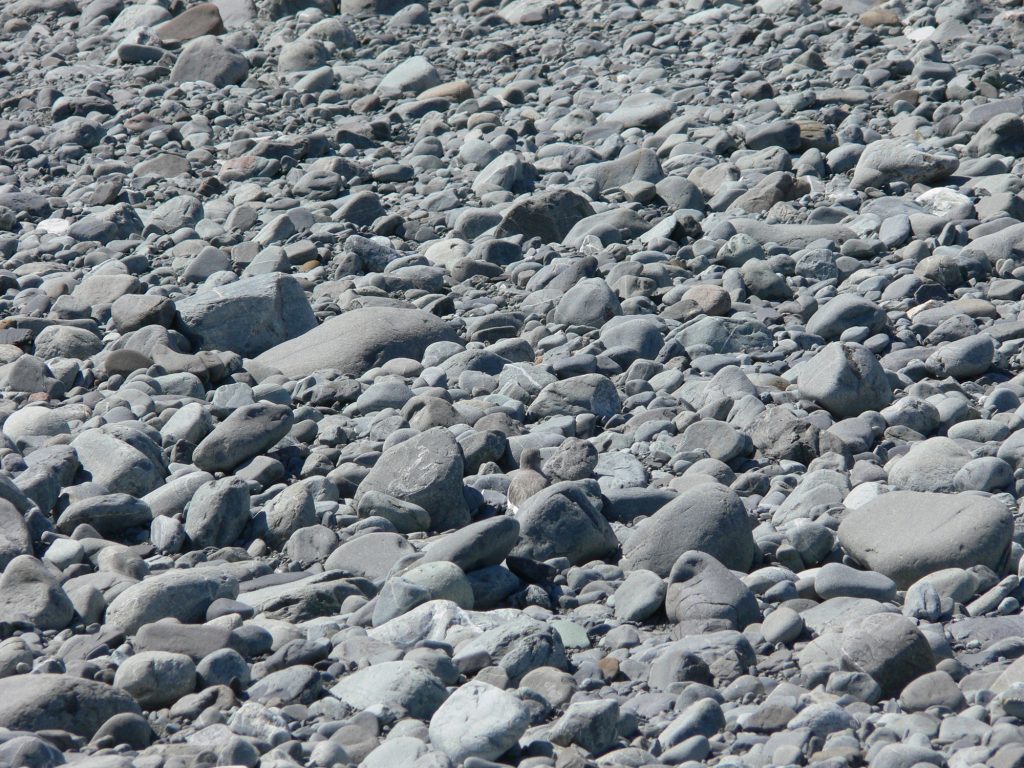
Yet it is not only bill shape that makes a Wrybill so superbly adapted to their riverbed-breeding environment. Stead considered the uniform steel grey of its upper plumage was of greater benefit to a bird than its bill. ‘It is sincerely to be hoped that this most interesting bird does survive, for, on its nesting ground, it exhibits in all its stages –adults, eggs, young- the most amazingly perfect protective colouration that there is among New Zealand birds.’ Likewise for Guthrie-Smith watching a bird on the lower Rakaia; ‘the grey-blue boulders, the splashed water edges, the stones half dry, half wet, darker or grey, the dusts and sands and gravels of the river. Every one of them is blended into his plumage.’ Shingle riverbeds are high contrast environments with strong light and deep shadow, but they are nevertheless very open, with few hiding places even for a small bird.’ Furthermore, in such terrain a colourful bird is rather obvious: oystercatchers and Paradise Shelducks are but two examples of other species in this environment that clearly demonstrate this.
Tactile feeding requires a bird to move more or less continuously, so becoming more visible to predators. Foraging along the stream edge may reduce its ability to detect predators ‘and selection for more cryptic pattern and colour would be strong.’ Hay suggests avian predators are a key factor behind Wrybill colouration. At least two raptors – New Zealand Falcon and the extinct Forbe’s Harrier occurred on or around the riverbeds. Since human settlement both Black-backed Gull and Australasian Harrier have occurred in increased densities. During his study, Wrybill egg predation was not significant, but Hay did note the response of adults guarding chicks to the presence of Black-backed Gulls. This, together with indications that Wrybill avoid nesting in the vicinity of gull colonies, ‘provide strong evidence for the influence of avian predation on Wrybill evolution.’
Guthrie-Smith, H. 1925. Bird Life on Island and Shore. William Blackwood & Sons, Edinburgh
Stead, E.F. 1932. The Life Histories of New Zealand Birds. Search, London
Burton, P.J.K. 1972. ‘Some anatomical notes on the Wrybill’. Notornis 19:26–32
Hutton, F. 1873. ‘Notes by Captain Hutton on Dr. Buller’s “Birds of New Zealand” , with the Author’s Replies thereto’. TNZI 6, art. XXIX
Pierce, R.J. 1979. ‘Foods and feeding of the Wrybill (Anarhynchus frontalis) on its riverbed breeding grounds’. Notornis 26:1–21
Potts, T.H. 1870. On the Birds of New Zealand. TNZI 3:93–97
Turbott, E.G. 1970. ‘The wrybill: a feeding adaptation’. Notornis 17: 25–27
Hay, J.R. 1984. ‘The behavioural ecology of the wrybill’. Unpublished PhD thesis, University of Auckland
Pierce, R.J. 1976. ‘The feeding ecology of wrybills in Canterbury. Unpubl postgraduate diploma in science thesis, University of Otago
As the Age of Discovery unfolded and ships from Europe spread over the globe, specimens of exotic flora and fauna flowed back into museums and private collections. Some plants, birds, animals and insects bore similarities with specimens already familiar to natural scientists. Others though, were downright weird, and among the strange new birds being exposed to Old World scrutiny an inordinate number seem to come from New Zealand. The kiwi for instance, at first thought to be a mischievous collector’s composite, or the giant moa – too big to be a bird surely? Then there was the Ngutu Pare Wrybill.
Ngutu Pare Wrybill caused raised eyebrows among scientists. The first specimen was collected from the Waitemata Harbour in February 1827 by naturalists on the French ship Astrolabe. They couldn’t help but notice the peculiar sideways turned bill, but was it just an aberration? Unfortunately for other birds nearby, several more were shot to confirm that it was not: all birds had their beak bent to the right.
Tactical on tidal flats.
Like a Swiss army knife, their bill is a multi-purpose instrument. Birds probe beneath submerged river stones for caddis fly or may fly larvae. Good food out of reach of more conventional bills.
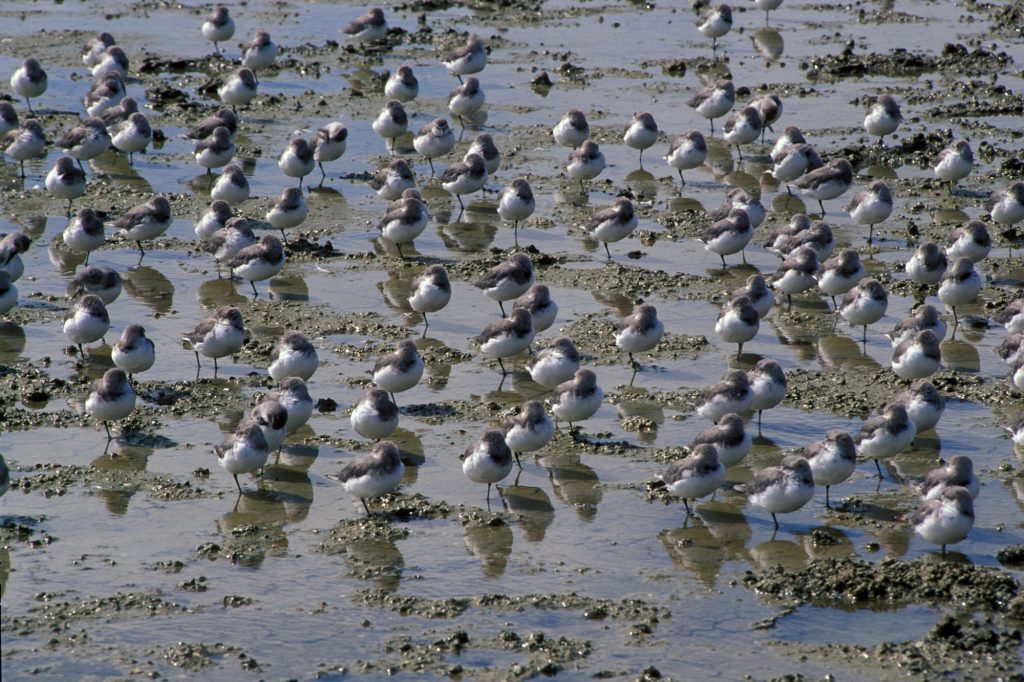
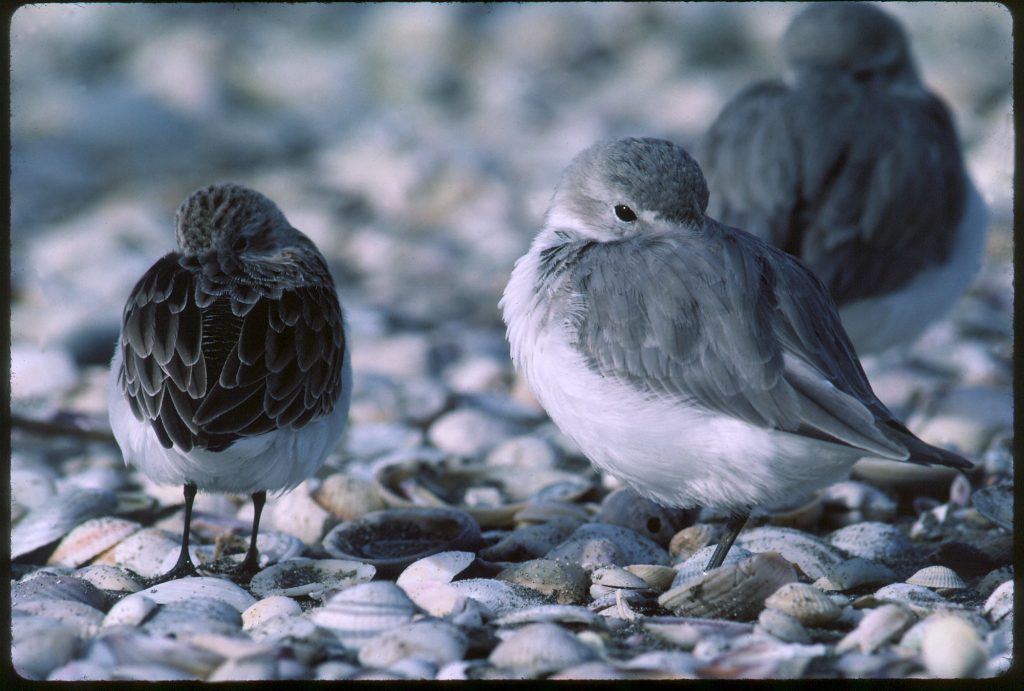
After breeding, Ngutu Pare Wrybills migrate north, most of the population heading for the Manukau Harbour and Firth of Thames. There on the soft tidal flats another feature of the bill emerges. On the vertical axis inside the curve, the upper and lower mandibles slope inwards. With its head held to the side, the bird now has a bill resembling a shallow spoon. From a great distance, the distinctive flick of its head identifies a foraging Ngutu Pare Wrybill, as it sifts through the biofilm layer on the mud surface, seeking micro-organisms such as diatoms. Yet the bill can also extract a worm from the mud, like any other bird on the flats
Come to Pūkorokoro for The Wryforce Airshow
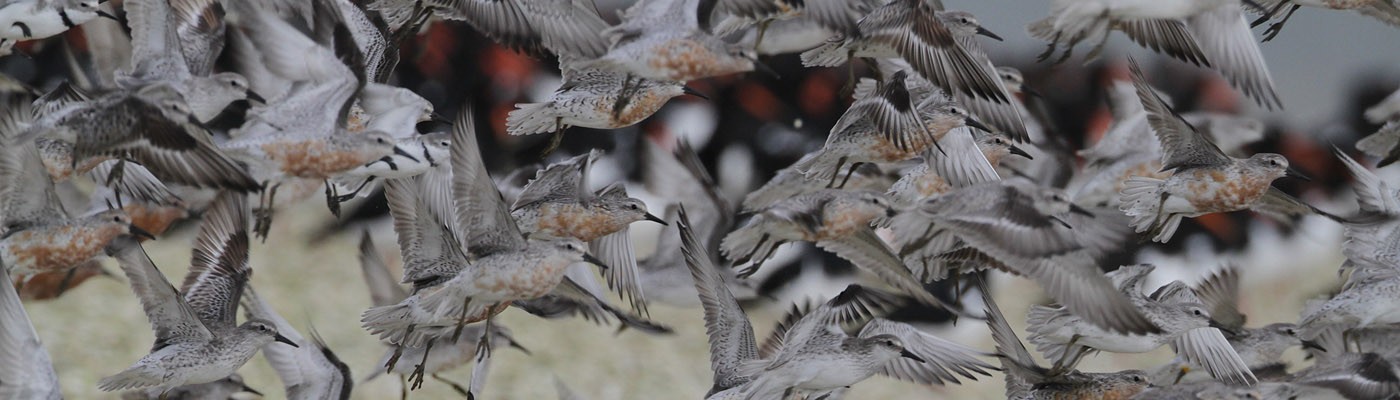
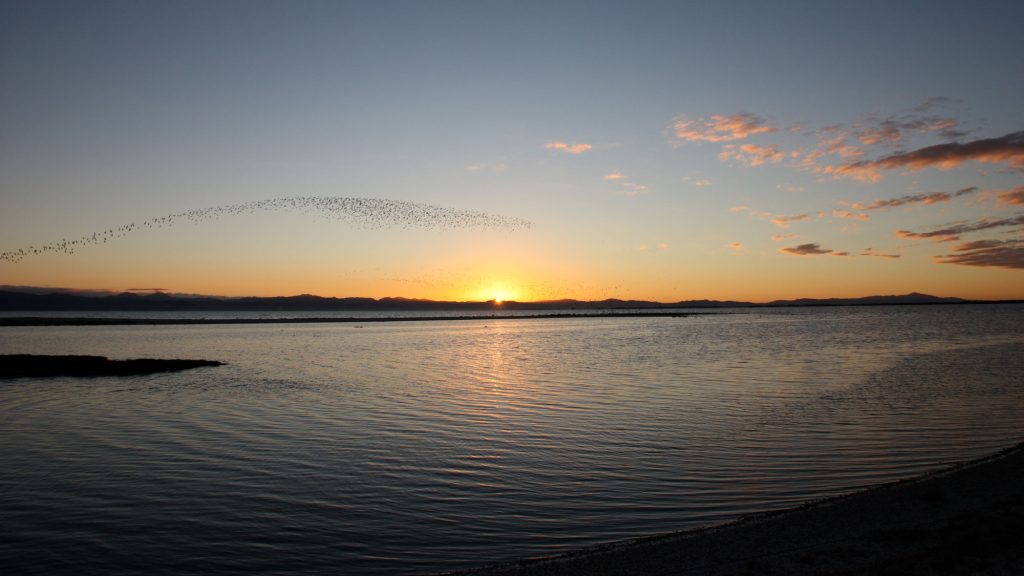
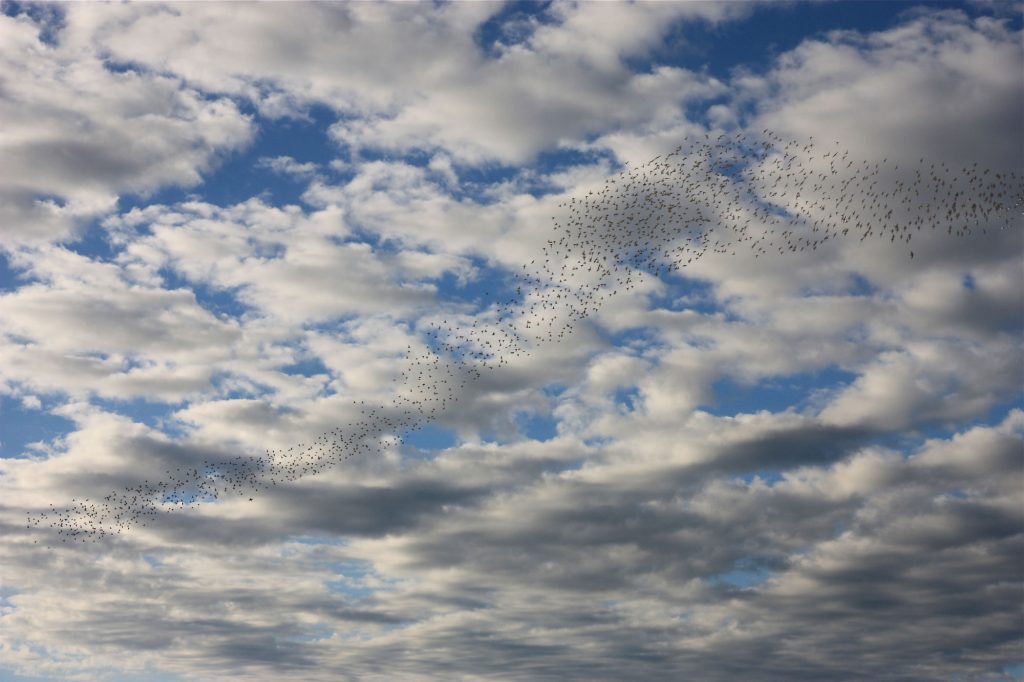
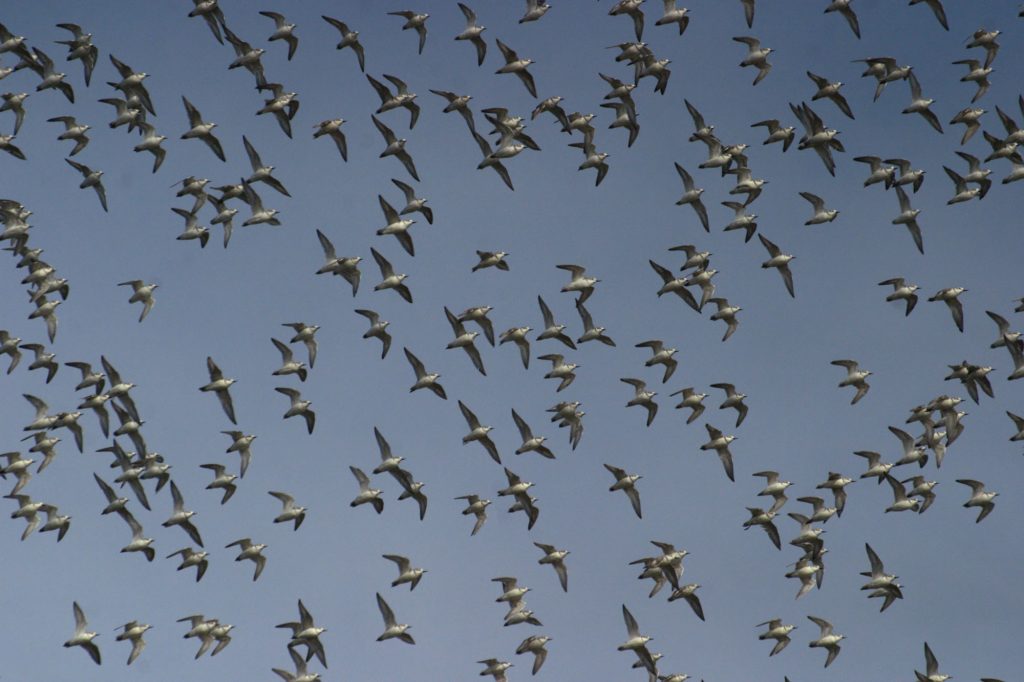
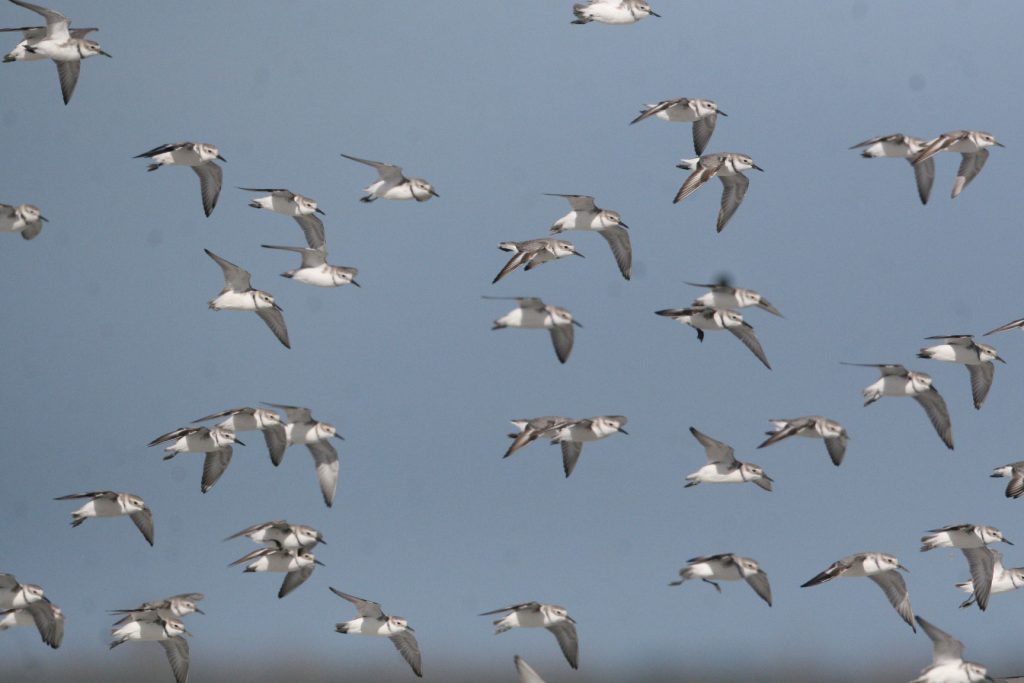
Each year, from late December to August, Pūkorokoro hosts a flock of 2,000 Ngutu Pare Wrybill, which is nearly half the world population. If you visit at that time you may be treated to a breathtaking performance of aerobatics. The flock erupts off the roost to perform prolonged aerial ballets. Painted across the sky they twist, undulate, swoop and spiral. Frenetic twists and turns are followed by languid loops as the flock tease apart then coalesce, flashing white underparts twisting to dark as, turning away in unison, they reveal their grey upperparts. A string of birds peel off and spiral down like unravelled wool hung across the sky, before twisting and spooling upwards. A spectacle that is always enthralling.
Cryptic on the rivers.
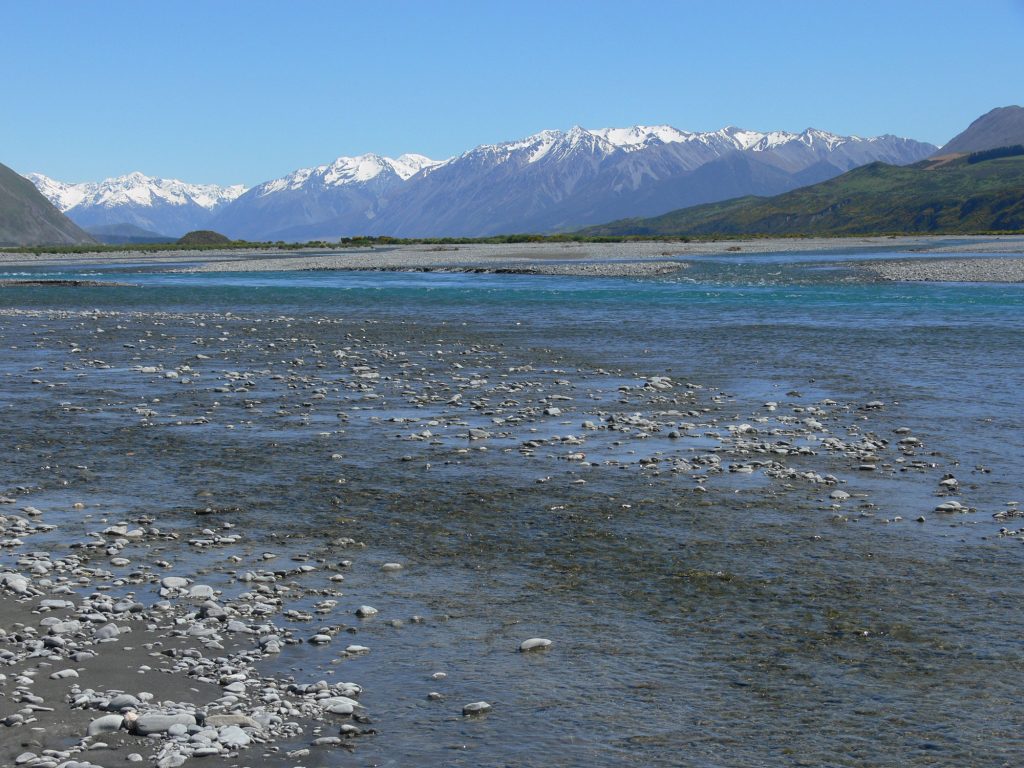
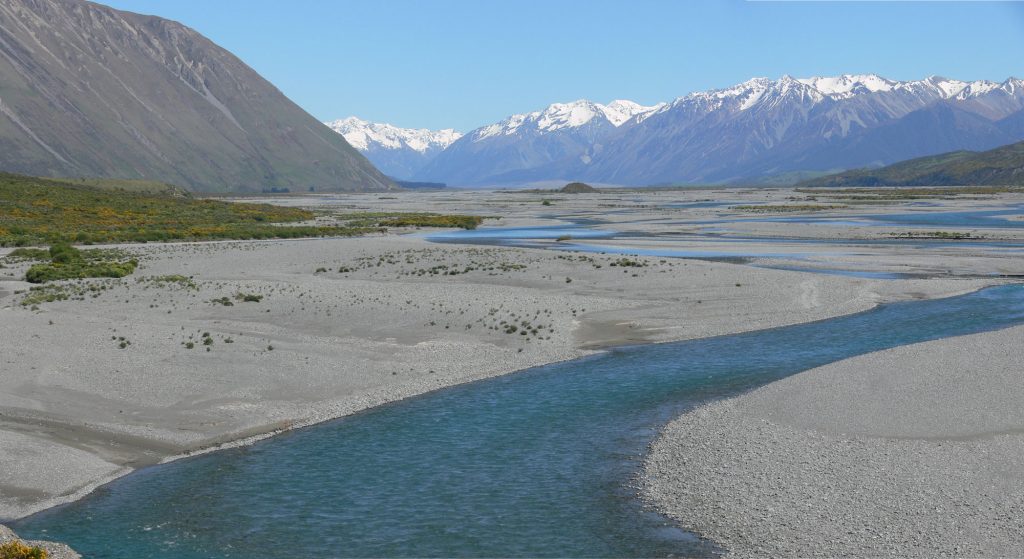
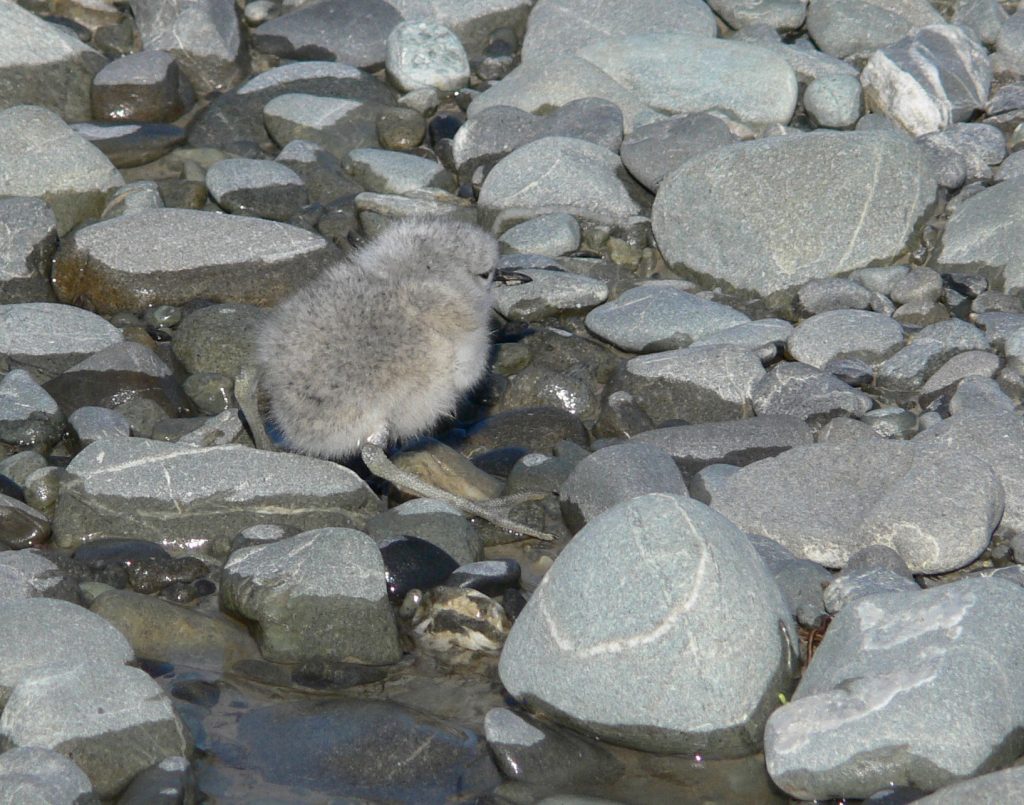
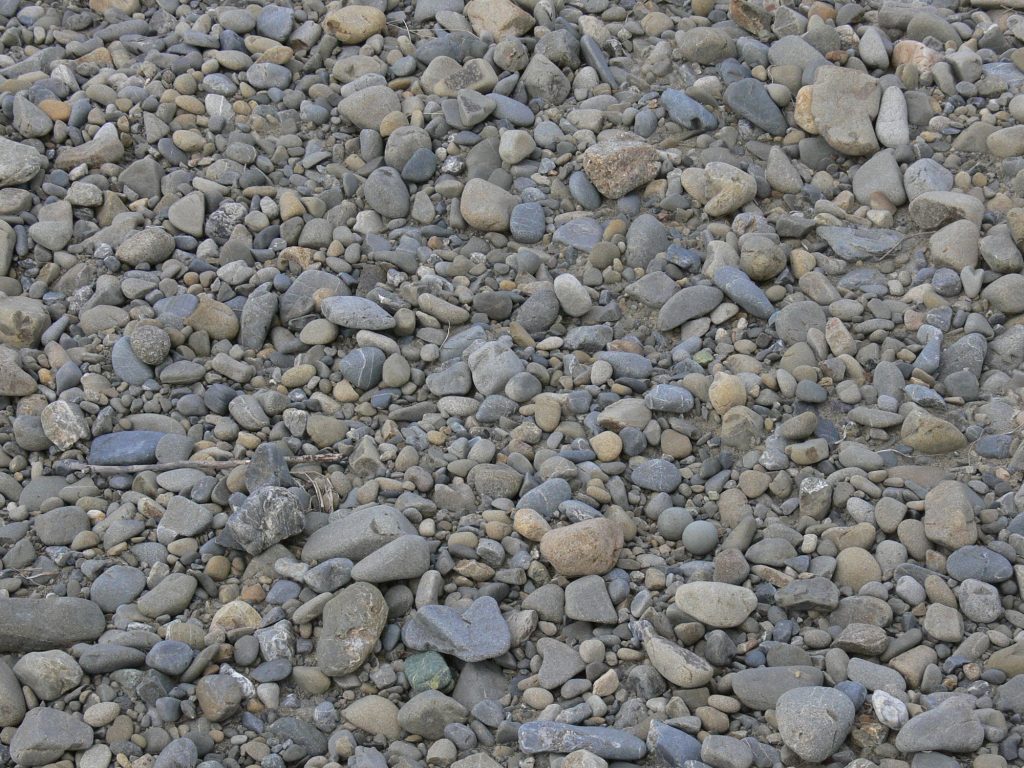
Ngutu Pare Wrybills breed in awesome landscapes, in the true meaning of that word. From September the Wryforce disperses over the broad braided reaches of the rivers such as the Waimakariri, Rakaia or Rakitata, or the Upper Waitaki system, those tumbling channels of water, milky green with glacial silt, against an alpine backdrop. Among swathes of river gravel and ground hugging plants, are nests impossible to see. Unless the incubating bird moves. The eggs and chicks are similarly cryptic, precisely adapted to that environment. Youngsters scarper and stumble over the stony flats, ready to freeze into invisibility if a parent alarms.
So an endearing and charismatic little bird, right?
Yet despite all this, Ngutu Pare Wrybills remain relatively unknown to many people in New Zealand. Which brings us back to those riverbeds where birds breed, and the severe stress those habitats are under. Reduced natural flows through land use practices that enable weed encroachment that in turn stabilises gravel bars and beaches, thus inhibiting the dynamic movement of channels and islands. The invasive vegetation also provides habitat and cover for predators. Disturbance from human activities such as vehicles on the riverbeds adds to the pressure. The ultimate outcome is modified riverbeds and degraded nesting habitat for Ngutu Pare Wrybill, and other species such as Tarapirohe Black-fronted Tern, Kaki Black Stilt, and Pohowera Banded Dotterel.
Much work is being done to address these major issues, and this needs to be supported. The resources need to be available for much more to be done, and sustained, if we want to secure a future for Ngutu Pare Wrybill. So, we need Ngutu Pare Wrybills to be firmly placed on the radar screen of Kiwis.
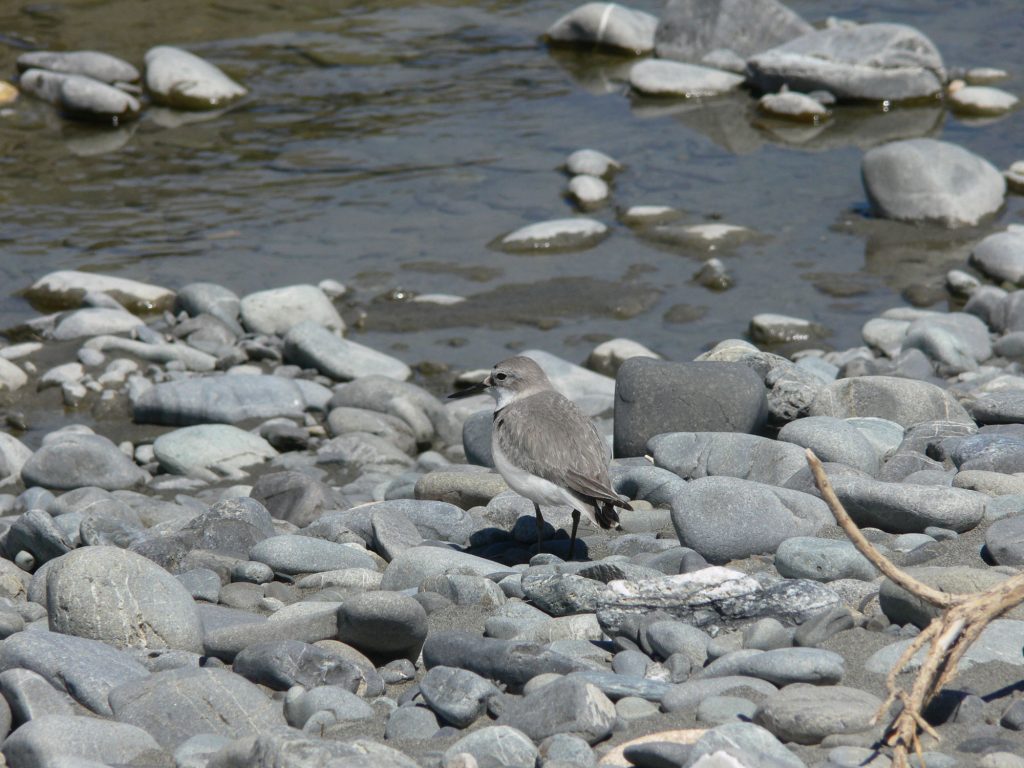
Like a Swiss army knife, it is a multi-purpose bill. Scraping around beneath submerged river stones for caddis fly or may fly larvae. Good food out of reach of other more conventional bills. On northern tidal flats the distinctive flick of its head identifies a foraging Ngutu Pare Wrybill from a great distance, as it sifts through the biofilm layer on the mud surface, seeking micro-organisms such as diatoms. Yet also using the bill to yank a worm from the mud, like any other bird on the flats.
Life with a Twist: Discovering the purposes of that strange bill
Yet despite all this, Ngutu Pare Wrybill remain relatively unknown to many people in this country. Which brings us back to those riverbeds where birds breed, and the severe stress those habitats are under. Reduced natural flows through land use practices, that enable weed encroachment that in turn stabilises gravel bars and beaches, thus inhibiting the dynamic movement of channels and islands. The invasive vegetation also provides habitat and cover for predators. Human activity such as vehicles on the riverbeds adds further pressure. The ultimate outcome is modified riverbeds and degraded nesting habitat for Ngutu Pare Wrybill, and other species such as Tarapirohe Black-fronted Tern, Kaki Black Stilt, and Pohowera Banded Dotterel.
Much work is being done to address these major issues, and this needs to be supported. The resources need to be available for much more to be done, and sustained, if we want to secure a future for Ngutu Pare Wrybill. So, a year of national publicity for these endearing creatures is what we are after. And for Ngutu Pare Wrybill to be firmly placed on the radar screen of Kiwis.
So join us in our campaign!
Ngutu Pare Wrybill for Bird of the Year 2026!
How you can help
- Vote for the Ngutu Pare Wrybill when the time comes this year.
- Tell a friend or neighbour – many people have never heard of this amazing little bird!
- Print or share a poster in your local café, shop, or library
- Sign up to our newsletter for updates and learn more about the Ngutu Pare Wrybill’s incredible journey.
- Support our work to protect nesting sites on braided rivers and feeding grounds at Pūkorokoro