Pūkorokoro Miranda News – February 2026 Issue 139
This issue includes a summary of the 12th meeting of Partners in the Philippines held in November last year, gulls and terns establishing new breeding colonies, along with more news and updates.

Flyway Gathering in the Philippines
David Lawrie reports on the Meeting of Partners held in November.
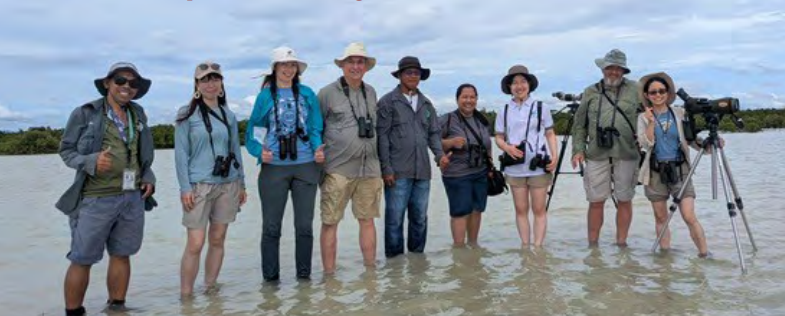
Early in November I represented the Trust at the 12th meeting of Partners (MOP12) of the East
Asian-Australasian Flyway Partnership which was held on Cebu Island in the Philippines. There were
over 200 people in attendance representing most of the partners with many observers, particularly from
nearby countries. Several site managers attended the meeting with funding from the Asian Development
Bank.
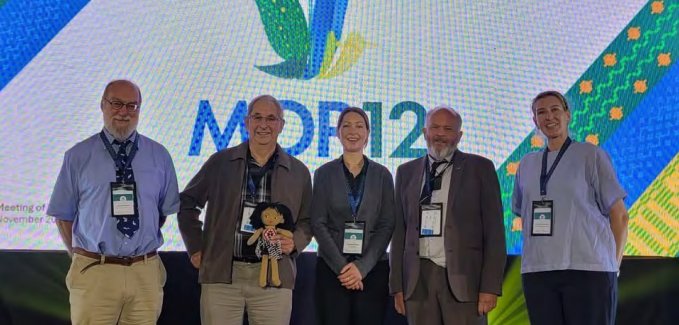
The Pūkorokoro delegation consisted of myself and Bruce McKinlay, although in one of the first acts of the event Bruce was elected Vice Chair of the meeting, a mark of the respect with which he is held within the Partnership. I therefore invited Dr Naya Brangenberg, one of New Zealand’s leading experts on infectious diseases, to stand as an observer as part of our delegation. She was there as part of the technical sub-committee to which she was formally elected later in the meeting.
As the host country the Philippines appointed Ms Mariglo Laririt Chair of the meeting. The Chair of the Flyway Partnership, Narelle Montgomere handed over the gavel and resumed her seat as the Australian delegate for the rest of the event.
There were powerful opening statements from Dr Musonda Mumba, Secretary General of the Convention on Wetlands and Miss Amy Fraenkel, Executive Secretary of the United Nations Convention on the Conservation of Migratory Species of Wild Animals (CMS). The speakers emphasised the importance of the work of the Flyway, and efforts taken by the partners to preserve bird habitats to ensure benefits for ecosystems for all species throughout the region.
There was also an opening address by Scott Morris, Vice President for the East Asian Region of the Asian Development Bank who, in conjunction with EAAF partners, have a project to enhance wetlands for the benefit of birds and people.
Certificates were issued to the new Flyway Network sites of which there were two in Myanmar, one in the Republic of Korea, one in Thailand and three in the Philippines.
Unfortunately, our application for the Manukau Harbour did not quite get completed in time but will be finalised early in 2026.
Once the pleasantries had been completed reports were then provided by the Management Committee, the Finance Committee, the Technical Sub-committee, and the Secretariat. The Secretariat report highlighted the fact that they were having trouble managing their budgets to meet expectations loaded on them by partners as well as ongoing costs of managing the partnership office. The strategic plan adopted several years ago was giving good guidance, but this needed review and partners should take this into consideration during the forthcoming period leading to MOP13. CEO Jennifer George mentioned how grateful she was for the ongoing support of the Incheon Metropolitan Government which host the Secretariat and provide much of its working capital.
At the end of the first day, with the weather fine and the temperature still warm, we were hosted to an outside dinner. It was a little unusual to have bats flying around over the dinner tables, but they caused no issues. On the second day we started on the actual resolutions. The Partnership has an unusual democratic system in which resolutions are approved by consensus in a two-stage process. The resolutions are first discussed during which points of views are put forward, and then motions are put aside, giving the proposer the opportunity to refine the resolution, taking into consideration any points raised, before re-submitting it later in the meeting for formal adoption.
The following motions, are I believe, relevant to our work at Pūkorokoro Miranda.
Flyway Site Network:
While 1,060 sites within the Flyway have been identified as qualifying to be Network Sites, only 159 have been formally designated. Of these, 106 have outdated or missing site information sheets and boundary maps and this is something that we should investigate for the Firth of Thames Site, to make sure it is up to date.
Flyway Network Site Information Sheets:
Following on from the MOP11 meeting the Flyway Network Site information sheet has been upgraded to simplify the form, ensure it contains more relevant information, and to make it easier for applicants to complete. It should be noted that the Manukau Harbour application has been prepared in accordance with the new sheet and has been verified by the Technical Sub-committee, so we are expecting no difficulties once we have completed the consultation that is underway.
Colour Marking of Shorebirds:
This is a contentious matter that has been causing issues throughout the Flyway. The original co-ordination scheme was introduced by the Science Officer, who was employed by the Partnership about 10 years ago. That programme allocated basic unique combinations of readable colour marks to each country in the Flyway, but difficulties have arisen because some countries or sub-regions have introduced their own colour combinations. This is largely because some countries do not have their own national bird banding officers and hence there is no co-ordination in the country itself.
This has caused some real confusion because band combinations are being observed that have not been officially allocated and hence the data cannot be reported and the information therefore has no relevance. A small taskforce has been established, including David Melville, to try to untangle the issues that have occurred and set very clear guidelines for the future. The use of colour marking on migratory birds is a very useful tool but only if there are clear standards.
Light Pollution Guidelines:
The Australian Government representative updated the meeting and introduced guidelines on International Light Pollution. This is particularly relevant for migratory species and was adopted at the CMS COP14 in 2024.
These guidelines provide best practice lighting design principles, and a risk based adaptive management framework to assess and manage the impact of artificial light with taxa specific guidance. Light pollution is being recognised as a disruptive influence on long distance migratory birds but also those closer to home such as Tāiko Black Petrel and Tītī Cooks Petrel, which have been similarly influenced.
EAAFP Tidal Flats Initiative:
On behalf of the Trust earlier in the year, I offered our support to be one of the co-sponsors of the tidal flats initiative. This was a proposal to raise awareness throughout the Flyway that tidal flats and working coastal wetlands associated with them, such as saltpans, agricultural ponds and sewage works, not only provide feeding areas but also much needed high tide roost sites. These working coastal wetlands are most important habitats for millions of migratory water birds and provide a multitude of vital eco-system services.
However, they are also the rarest category of wetland in the world and are being destroyed by the inappropriate planting of mangroves, sea grass and salt marsh, and abandonment of working coastal wetlands. The tidal flats initiative is particularly significant as five of the eight top countries covering half of the world’s total area of tidal flats are in the EAAF: Indonesia, China, Australia, United States and Myanmar. (See Pūkorokoro News 138)
While the motion itself was defensive in that it was intended to prevent the loss of any further wetlands, I pointed out that initiatives should also be investigated to examine opportunities to restore previously destroyed wetlands by breaking down sea walls and re-flooding areas, such as has happened at Piako. That was an opportunity that had not been considered although others realised that opportunities
existed within their own countries.
Migratory Land Birds:
This was a proposal to include migratory land birds within the Flyway Partnership. It was explained that some of these birds, particularly species of open habitat had suffered most severe global declines in the last few decades. This contrasts with water bird species which are generally stable or are recovering due to enhanced protection offered by the Flyway Partnership. The proposer of the motion was recommending that an ad hoc committee be established to discuss the feasibility of including migratory land birds into the species scope of the EAAFP and reporting to the next meeting of Partners.
This proposal met mixed comments until I broke with the normal protocol by declaring that I would not support the motion in its present form and would vote against it. That was greeted with a mixture of consternation and relief in equal measures throughout the room as others had felt the same way but were not prepared to make their feelings so clearly obvious. My objection to the proposal was that the Partnership did not have the financial or human resources available to take on the extra loading that it would have imposed on the Secretariat.
The proposal was put aside, and two meetings were held to try to refine it and make it more palatable. When it was ultimately reported back, I did support the motion in its revised form to have the proposal further considered.
The other items of interest were the election of officers. As reported previously we had nominated Bruce McKinlay for a position as the NGO partner representative on the management committee. This was duly confirmed by the Partnership, so Bruce is now representing the Trust on that committee. As mentioned earlier Bruce is held in high regard by the Partnership and was appointed Vice Chair of the meeting because of his experience and knowledge of the workings of the Partnership. He will ably represent the Trust in this important position.
The Trust was also involved in nominations to the Technical Advisory Group by seconding the application of Dr Birgita Hansen from the Australasian Wader Studies Group. We also supported the appointment of Dr Naya Brangenberg from New Zealand who was the Trust’s supporter throughout the meeting. She effectively replaces David Melville on that committee because he had served his two terms.
Overall, it was a productive meeting in which I believe the Trust was well represented. From the comments I have received the input provided by the Pūkorokoro people were well received and were productive, and it is clear from the positions that are now held within the Partnership that the Trust and New Zealand are seen as worthwhile partners I would take the opportunity to thank the Philippines Government and and the city of Lapu Lapu for hosting the MOP on Cebu Island. The Island was rocked by an earthquake a month before the meeting which caused considerable damage, and then hit by a typhoon two days before the
meeting which caused major flooding and further damage. However, the city rose above these difficulties and provided a very warm welcome to the 200 delegates. There were very little physical signs of the damage, and people were all friendly and helpful.
A big thanks also to Jennifer George and her team who ensured that the logistics of the meeting ran smoothly and kept to time with the documentation always available. A big task performed very well.
You can read the full magazine including many other articles here.
Robert Findlay Wildlife Reserve 10 Years On
In 2016 The Trust achieved the long-held goal of acquiring the Robert Findlay Wildlife Reserve. When the Trust was formed in 1975, acquiring land at the Limeworks quickly became its focus. This was where the founders envisaged a bird observatory would be built. That was certainly the aspiration of Ronald Lockley, who had wide experience of such places in his native Wales and elsewhere in Britain and Europe. However, difficulties around land tenure soon emerged which, together with opposition from the New Zealand Wildlife Service, became insurmountable hurdles.
Gulls and Terns
The Tarapuka Black-billed Gulls and Tara White-fronted Terns on the shell bank did themselves a big favour this season. By returning to establish breeding colonies after an absence of several years, they confirmed to Hauraki District Council (HDC) the need for a bylaw change.
Screening for HPAI Bird Flu
New Zealand has so far evaded the high pathogenicity avian influenza (HPAI) that has been sweeping around much of the world, decimating bird populations. However, that situation might change in the coming months or years. If it does arrive in New Zealand, which route is it likely to take to get here? How do we prepare? Adrian Riegen reports on a program of screening birds for the virus.